
Funding our Destination 2027
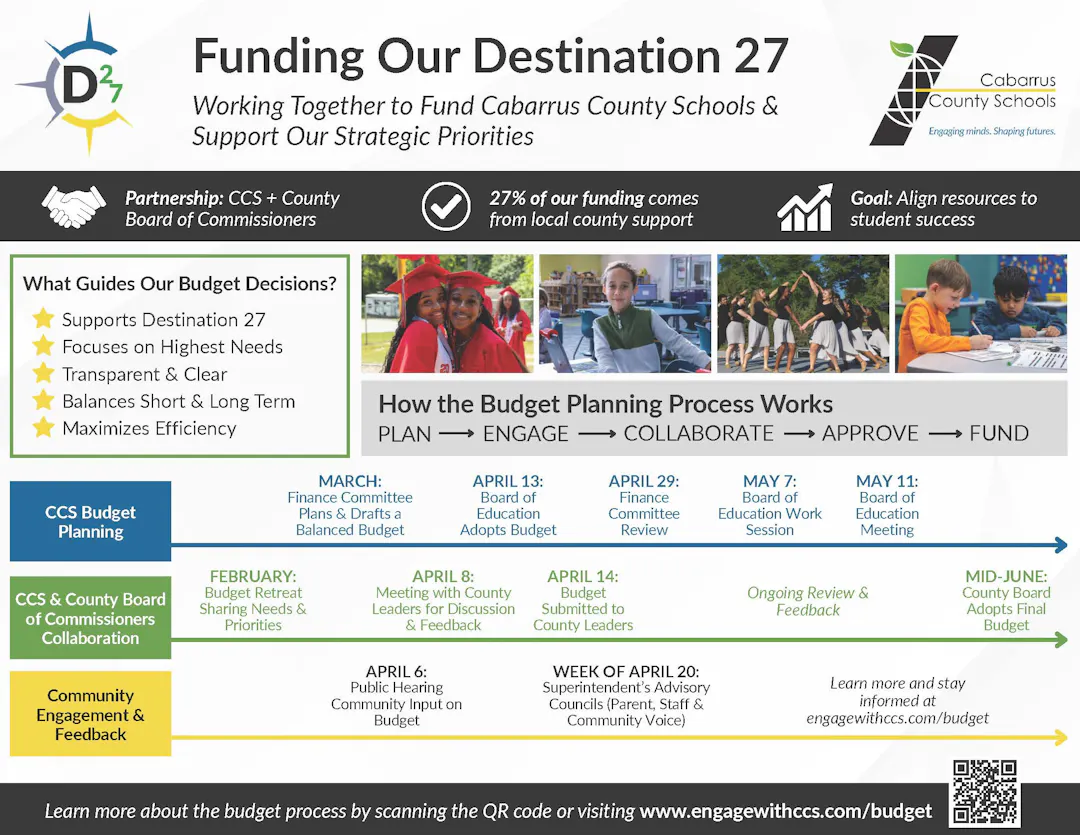
Developing Our Budget and Next Steps
Share your questions or suggestions by using the tools below.
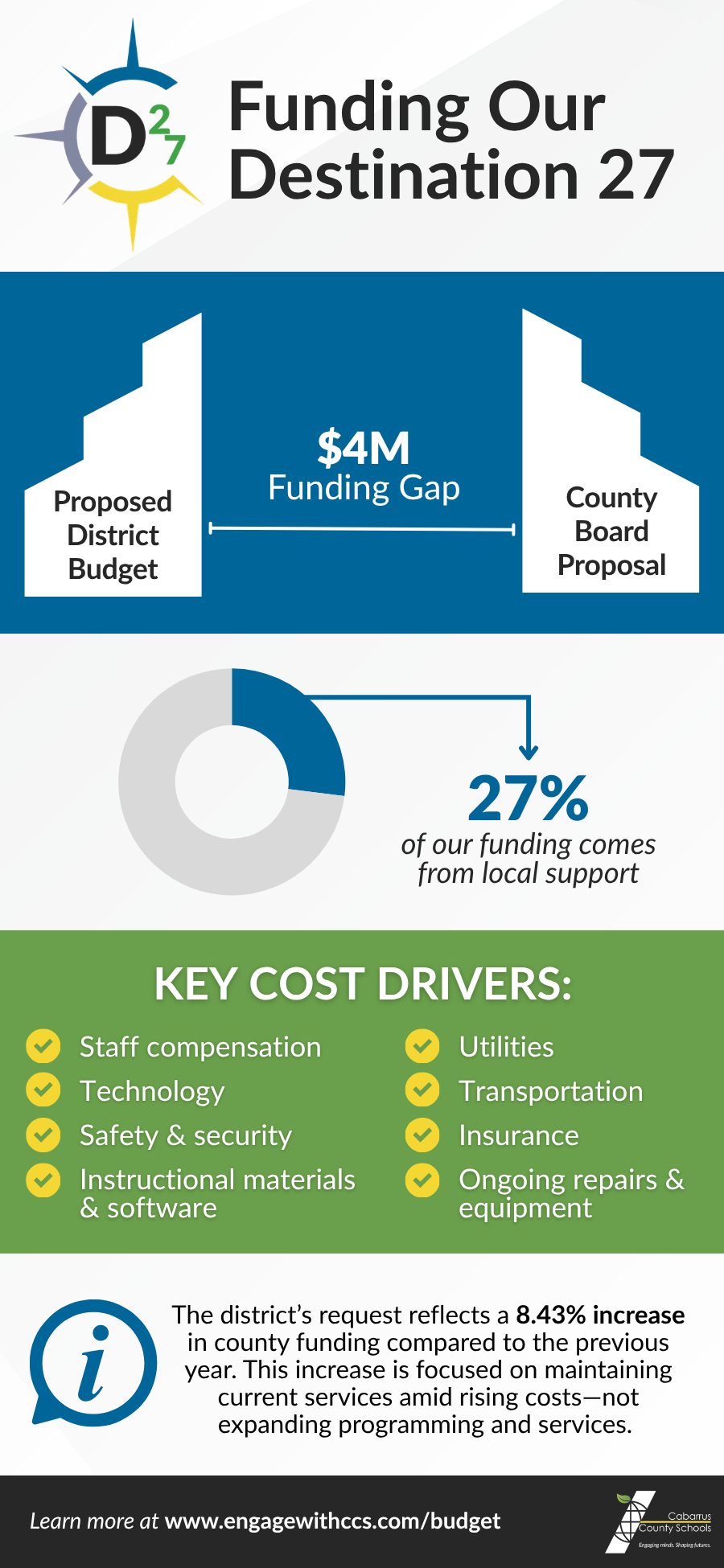
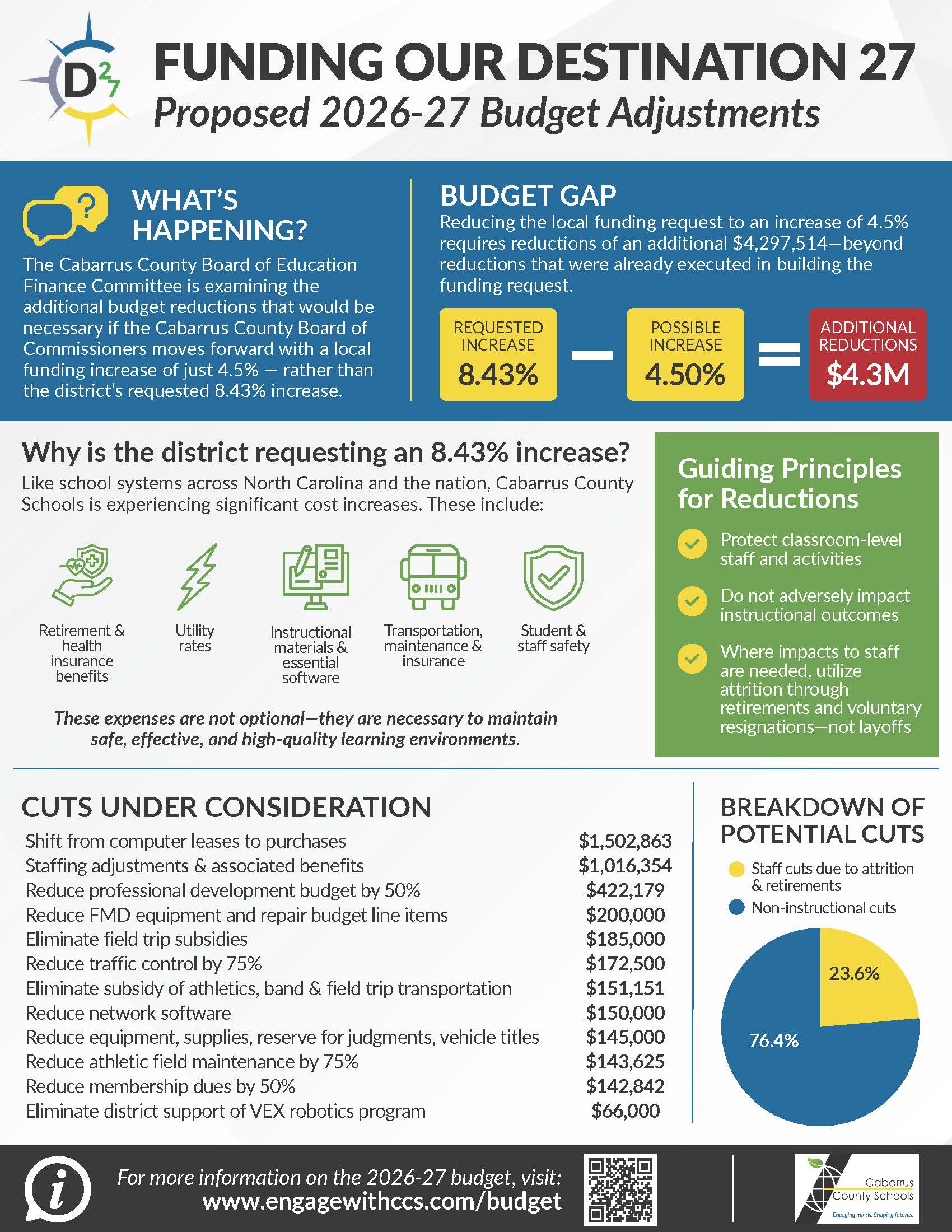
Developing Our Budget and Next Steps
Share your questions or suggestions by using the tools below.
Submit your budget questions here
Have a question about the CCS budget? Please leave a question regarding the current 2026-27 budget process and district staff will respond as soon as possible.
-
Share Can you share the way you gathered the data claiming that 1:1 in kindergarten is strongly supported by most teachers? Is there data that proves its instructional value beyond iReady? on Facebook Share Can you share the way you gathered the data claiming that 1:1 in kindergarten is strongly supported by most teachers? Is there data that proves its instructional value beyond iReady? on X (formerly Twitter) Share Can you share the way you gathered the data claiming that 1:1 in kindergarten is strongly supported by most teachers? Is there data that proves its instructional value beyond iReady? on Linkedin Email Can you share the way you gathered the data claiming that 1:1 in kindergarten is strongly supported by most teachers? Is there data that proves its instructional value beyond iReady? link
Can you share the way you gathered the data claiming that 1:1 in kindergarten is strongly supported by most teachers? Is there data that proves its instructional value beyond iReady?
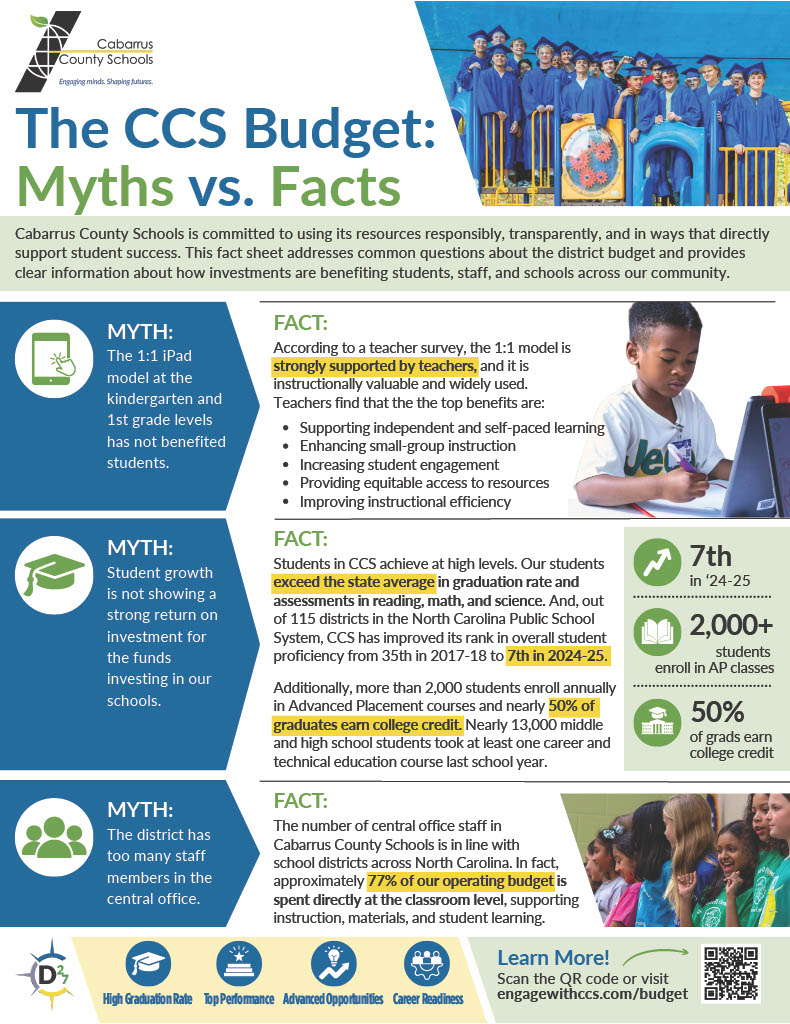
April asked 5 months agoThank you for your question and participation. The following is a summary of responses from Kindergarten and 1st Grade teachers regarding the district’s 1:1 iPad model. The survey, conducted this spring, received 221responses, representing over 80% of Kindergarten and 1st Grade teachers in Cabarrus County Schools.
- What grade level do you teach or primarily support?
Response Distribution:
· Kindergarten: 46.6%
· 1st: 53.4%
- In your class, how frequently do students use their assigned iPads during a typical school day?
Response Distribution:
· Daily (multiple times per day): 57.5%
· Daily (once per day): 24.9%
· A few times per week: 14.9%
· Rarely: 2.7%
- In your class, how much total time do students use their assigned iPad device in a typical week?
Response Distribution:
· 0 to 1 hour (less than 15 minutes per day): 19.9%
· 1 to 3 hours (approximately 15-30 minutes per day): 55.2%
· 3 to 5 hours (approximately 30-60 minutes per day): 24.4%
· 5-10 hours (approximately 60-120 minutes per day): 0.5%
- In what ways are iPads regularly used in your classroom? (Check all that apply.)
Response Distribution:
· Assessment (DIBELS): 85.5%
· iReady diagnostic: 85.5%
· Individual/independent tasks (reading digital texts): 79.6%
· Small group instruction (students using as part of a rotation or small group): 77.8%
· Adaptive instructional tools (iReady instruction): 76.0%
· Whole group instruction (all students using as directed by the teacher): 43.0%
- To what extent do you believe the 1:1 iPad model supports student learning?
Response Distribution:
· Significantly improves learning: 50.7%
· Somewhat improves learning: 38.5%
· No noticeable impact: 6.3%
· Somewhat hinders learning: 3.6%
· Significantly hinders learning: 0.9%
- What are the primary benefits of having a 1:1 iPad for each student in your classroom?
Summary of Open-Ended Responses:
· Supports small-group instruction and teacher flexibility: The most common theme was that iPads allow students to work independently while teachers provide targeted small-group instruction, interventions, or individualized support to other students.
· Promotes independent learning and student engagement: Many teachers reported that students are able to complete assignments, practice skills, and engage with learning activities more independently and with greater focus.
· Improves access to digital instructional tools and assessments: Teachers frequently referenced the ease of administering programs such as iReady, DIBELS, and other digital learning tools. Respondents noted that having an individual device eliminates wait time and increases instructional efficiency.
· Allows for personalized and differentiated instruction: Teachers emphasized that 1:1 access helps meet individual student needs by allowing students to work at their own level and pace through adaptive instructional programs and targeted practice activities.
· Increases instructional efficiency and reduces downtime: Respondents commonly noted that immediate access to devices saves time, streamlines transitions, and allows learning activities to begin quickly without sharing or rotating devices.
· Provides equitable access for all students: Several teachers highlighted that a 1:1 model ensures every student has equal access to learning resources, digital content, and instructional opportunities.
- What challenges or concerns have you experienced with the 1:1 iPad model?
Summary of Open-Ended Responses:
· No/minimal concerns were the most common response: Respondents repeatedly indicated that while challenges exist, the instructional benefits of the 1:1 model outweigh the difficulties when devices are used strategically and with appropriate classroom structures in place.
· Student distraction and off-task behavior: Teachers noted that some students require close monitoring to remain focused during instructional activities.
· Balancing screen time with hands-on learning: Many respondents emphasized the importance of maintaining a healthy balance between digital instruction and traditional, hands-on classroom experiences. Teachers generally supported the use of iPads when used intentionally and in moderation.
· Device management and classroom monitoring: Teachers reported that managing student devices can sometimes be time-consuming, particularly when troubleshooting issues, monitoring appropriate use, or helping young students navigate applications independently.
· Technical issues and reliability concerns: Common operational concerns included app glitches, connectivity problems, audio issues, charging difficulties, and occasional device malfunctions that interrupt instruction.
· Over-reliance on technology: Some teachers expressed concern that students may become too dependent on digital tools for learning tasks that also require development of foundational hands-on, writing, or interpersonal skills.
· Student maturity and developmental readiness: A smaller number of responses noted that some Kindergarten and 1st Grade students may struggle with the responsibility and self-regulation required for consistent independent device use.
- Overall, how necessary is the 1:1 iPad model to meeting your instructional goals, compared to shared or limited-access models (small group sets, carts, etc.)?
Response Distribution:
· Very critical ("I could not meet my instructional goals with anything less than 1:1 iPads."): 36.7%
· Somewhat critical ("I could meet my instructional goals without 1:1 iPads but a different model would result in additional challenges."): 51.1%
· Not critical ("I could meet my instructional goals as effectively with a different model and/or less devices."): 12.2%
- Please use the space below to provide any other input or feedback regarding the 1:1 iPad model.
Summary of Open-Ended Responses:
· Strong overall support for maintaining the 1:1 model: Many teachers described the devices as an important instructional resource that has become integrated into daily classroom routines. Respondents frequently stated that they would not want to return to a shared-device model due to the efficiency and instructional flexibility provided by individual access.
· Support for differentiated and individualized instruction: Teachers repeatedly emphasized that the 1:1 model helps meet a wide range of student needs. Many noted that iPads allow students to work independently, receive personalized practice, and access adaptive learning tools while teachers provide targeted small-group instruction.
· Positive impact on instructional efficiency: Respondents commonly highlighted how iPads streamline assessments, learning stations, transitions, and independent practice. Teachers noted that immediate access to devices reduces lost instructional time and increases classroom productivity.
· Importance of balanced use: A recurring theme was that iPads are most effective when used intentionally and in moderation alongside hands-on learning, collaborative activities, and traditional instructional methods. Teachers generally did not advocate for excessive screen time, but rather for purposeful integration into instruction.
· Need for continued teacher oversight and structure: Several teachers noted that student success with devices depends heavily on clear expectations, monitoring, and structured classroom routines. Respondents emphasized that the devices are tools to support instruction—not replacements for teaching.
· Concerns about future funding or loss of devices: Some teachers expressed concern that reductions in device availability could negatively impact instruction, intervention programs, assessment administration, and differentiated learning opportunities currently embedded in classroom practices.
-
Share I read the article posted online on April 29, 2026 by Chris Miller. I have a few concerns regarding budget cuts. If there is a link to the budget online that shows the cost of what I'm asking below - please send me the link. I wasn't sure where to look. How much funding does the district provide for VEX Robotics? I'm assuming this would become a pay-to-code engineering club if district funds are cut. I realize cost could vary per student but what could be the average cost per student? How much is the district subsidies for athletics, band, and field trip transportation? This is going to become an equity problem for many of our schools. Parents and students may not be able to afford and they will be missing out on opportunities just due to funding. The district already provides little funding for field maintenance. Again this becomes an equity problem. Some Booster Clubs cannot get the support from parents because parents literally cannot afford to help. This could cause hazardous playing conditions. Increase injuries for our athletes. How much (on average) are key note speakers? I feel like Key Notes for the Leadership Summit, RISE, and other district meetings are not necessary the moment. Yes, they are motivating at the time but not necessary. Would it be cheaper to pay a teacher a stipend to become a "Teacher the Teacher". I don't know if that would be more beneficial to the budget. Or if an overworked, underpaid teacher would want to take on more for a stipend. I do not think K& 1 need to be 1:1 with iPads. 2nd grade does not need to be 1:1 with an iPad or a Chromebook. If it wasn't for state testing I do not think 3-5 need to be 1:1 with Chromebooks. "In the olden days" we used to do just fine with a couple of computer carts for a grade level to share. There is nothing wrong with pen and paper. Students would be forced to stay on task. Ian Patrick recently posted on social media as respects the article referenced above that Dr. Kopicki's salary is $262,000 and has increased 7% since 2023. I'm curious why Dr. Kopicki has received an increase and yet teachers are fighting everyday to get a raise. Plus I'm sure he receives travel expenses and meal vouchers. I realize he puts many hours into making sure the school system runs smoothly. He works all day, attends nightly events, and I'm sure some weekend events as well. I'm not saying his salary is too much. But he should not be receiving raises if teachers and school staff are not being paid fairly. Lastly, I would like to know how much we spend on district personnel to attend conferences including travel expenses, hotels, and meal vouchers. I realize it is important to keep up to date on practices. I attend a yearly conference as well. I pay for my own hotel, meals, and gas - sometimes my own registration fee. on Facebook Share I read the article posted online on April 29, 2026 by Chris Miller. I have a few concerns regarding budget cuts. If there is a link to the budget online that shows the cost of what I'm asking below - please send me the link. I wasn't sure where to look. How much funding does the district provide for VEX Robotics? I'm assuming this would become a pay-to-code engineering club if district funds are cut. I realize cost could vary per student but what could be the average cost per student? How much is the district subsidies for athletics, band, and field trip transportation? This is going to become an equity problem for many of our schools. Parents and students may not be able to afford and they will be missing out on opportunities just due to funding. The district already provides little funding for field maintenance. Again this becomes an equity problem. Some Booster Clubs cannot get the support from parents because parents literally cannot afford to help. This could cause hazardous playing conditions. Increase injuries for our athletes. How much (on average) are key note speakers? I feel like Key Notes for the Leadership Summit, RISE, and other district meetings are not necessary the moment. Yes, they are motivating at the time but not necessary. Would it be cheaper to pay a teacher a stipend to become a "Teacher the Teacher". I don't know if that would be more beneficial to the budget. Or if an overworked, underpaid teacher would want to take on more for a stipend. I do not think K& 1 need to be 1:1 with iPads. 2nd grade does not need to be 1:1 with an iPad or a Chromebook. If it wasn't for state testing I do not think 3-5 need to be 1:1 with Chromebooks. "In the olden days" we used to do just fine with a couple of computer carts for a grade level to share. There is nothing wrong with pen and paper. Students would be forced to stay on task. Ian Patrick recently posted on social media as respects the article referenced above that Dr. Kopicki's salary is $262,000 and has increased 7% since 2023. I'm curious why Dr. Kopicki has received an increase and yet teachers are fighting everyday to get a raise. Plus I'm sure he receives travel expenses and meal vouchers. I realize he puts many hours into making sure the school system runs smoothly. He works all day, attends nightly events, and I'm sure some weekend events as well. I'm not saying his salary is too much. But he should not be receiving raises if teachers and school staff are not being paid fairly. Lastly, I would like to know how much we spend on district personnel to attend conferences including travel expenses, hotels, and meal vouchers. I realize it is important to keep up to date on practices. I attend a yearly conference as well. I pay for my own hotel, meals, and gas - sometimes my own registration fee. on X (formerly Twitter) Share I read the article posted online on April 29, 2026 by Chris Miller. I have a few concerns regarding budget cuts. If there is a link to the budget online that shows the cost of what I'm asking below - please send me the link. I wasn't sure where to look. How much funding does the district provide for VEX Robotics? I'm assuming this would become a pay-to-code engineering club if district funds are cut. I realize cost could vary per student but what could be the average cost per student? How much is the district subsidies for athletics, band, and field trip transportation? This is going to become an equity problem for many of our schools. Parents and students may not be able to afford and they will be missing out on opportunities just due to funding. The district already provides little funding for field maintenance. Again this becomes an equity problem. Some Booster Clubs cannot get the support from parents because parents literally cannot afford to help. This could cause hazardous playing conditions. Increase injuries for our athletes. How much (on average) are key note speakers? I feel like Key Notes for the Leadership Summit, RISE, and other district meetings are not necessary the moment. Yes, they are motivating at the time but not necessary. Would it be cheaper to pay a teacher a stipend to become a "Teacher the Teacher". I don't know if that would be more beneficial to the budget. Or if an overworked, underpaid teacher would want to take on more for a stipend. I do not think K& 1 need to be 1:1 with iPads. 2nd grade does not need to be 1:1 with an iPad or a Chromebook. If it wasn't for state testing I do not think 3-5 need to be 1:1 with Chromebooks. "In the olden days" we used to do just fine with a couple of computer carts for a grade level to share. There is nothing wrong with pen and paper. Students would be forced to stay on task. Ian Patrick recently posted on social media as respects the article referenced above that Dr. Kopicki's salary is $262,000 and has increased 7% since 2023. I'm curious why Dr. Kopicki has received an increase and yet teachers are fighting everyday to get a raise. Plus I'm sure he receives travel expenses and meal vouchers. I realize he puts many hours into making sure the school system runs smoothly. He works all day, attends nightly events, and I'm sure some weekend events as well. I'm not saying his salary is too much. But he should not be receiving raises if teachers and school staff are not being paid fairly. Lastly, I would like to know how much we spend on district personnel to attend conferences including travel expenses, hotels, and meal vouchers. I realize it is important to keep up to date on practices. I attend a yearly conference as well. I pay for my own hotel, meals, and gas - sometimes my own registration fee. on Linkedin Email I read the article posted online on April 29, 2026 by Chris Miller. I have a few concerns regarding budget cuts. If there is a link to the budget online that shows the cost of what I'm asking below - please send me the link. I wasn't sure where to look. How much funding does the district provide for VEX Robotics? I'm assuming this would become a pay-to-code engineering club if district funds are cut. I realize cost could vary per student but what could be the average cost per student? How much is the district subsidies for athletics, band, and field trip transportation? This is going to become an equity problem for many of our schools. Parents and students may not be able to afford and they will be missing out on opportunities just due to funding. The district already provides little funding for field maintenance. Again this becomes an equity problem. Some Booster Clubs cannot get the support from parents because parents literally cannot afford to help. This could cause hazardous playing conditions. Increase injuries for our athletes. How much (on average) are key note speakers? I feel like Key Notes for the Leadership Summit, RISE, and other district meetings are not necessary the moment. Yes, they are motivating at the time but not necessary. Would it be cheaper to pay a teacher a stipend to become a "Teacher the Teacher". I don't know if that would be more beneficial to the budget. Or if an overworked, underpaid teacher would want to take on more for a stipend. I do not think K& 1 need to be 1:1 with iPads. 2nd grade does not need to be 1:1 with an iPad or a Chromebook. If it wasn't for state testing I do not think 3-5 need to be 1:1 with Chromebooks. "In the olden days" we used to do just fine with a couple of computer carts for a grade level to share. There is nothing wrong with pen and paper. Students would be forced to stay on task. Ian Patrick recently posted on social media as respects the article referenced above that Dr. Kopicki's salary is $262,000 and has increased 7% since 2023. I'm curious why Dr. Kopicki has received an increase and yet teachers are fighting everyday to get a raise. Plus I'm sure he receives travel expenses and meal vouchers. I realize he puts many hours into making sure the school system runs smoothly. He works all day, attends nightly events, and I'm sure some weekend events as well. I'm not saying his salary is too much. But he should not be receiving raises if teachers and school staff are not being paid fairly. Lastly, I would like to know how much we spend on district personnel to attend conferences including travel expenses, hotels, and meal vouchers. I realize it is important to keep up to date on practices. I attend a yearly conference as well. I pay for my own hotel, meals, and gas - sometimes my own registration fee. link
I read the article posted online on April 29, 2026 by Chris Miller. I have a few concerns regarding budget cuts. If there is a link to the budget online that shows the cost of what I'm asking below - please send me the link. I wasn't sure where to look. How much funding does the district provide for VEX Robotics? I'm assuming this would become a pay-to-code engineering club if district funds are cut. I realize cost could vary per student but what could be the average cost per student? How much is the district subsidies for athletics, band, and field trip transportation? This is going to become an equity problem for many of our schools. Parents and students may not be able to afford and they will be missing out on opportunities just due to funding. The district already provides little funding for field maintenance. Again this becomes an equity problem. Some Booster Clubs cannot get the support from parents because parents literally cannot afford to help. This could cause hazardous playing conditions. Increase injuries for our athletes. How much (on average) are key note speakers? I feel like Key Notes for the Leadership Summit, RISE, and other district meetings are not necessary the moment. Yes, they are motivating at the time but not necessary. Would it be cheaper to pay a teacher a stipend to become a "Teacher the Teacher". I don't know if that would be more beneficial to the budget. Or if an overworked, underpaid teacher would want to take on more for a stipend. I do not think K& 1 need to be 1:1 with iPads. 2nd grade does not need to be 1:1 with an iPad or a Chromebook. If it wasn't for state testing I do not think 3-5 need to be 1:1 with Chromebooks. "In the olden days" we used to do just fine with a couple of computer carts for a grade level to share. There is nothing wrong with pen and paper. Students would be forced to stay on task. Ian Patrick recently posted on social media as respects the article referenced above that Dr. Kopicki's salary is $262,000 and has increased 7% since 2023. I'm curious why Dr. Kopicki has received an increase and yet teachers are fighting everyday to get a raise. Plus I'm sure he receives travel expenses and meal vouchers. I realize he puts many hours into making sure the school system runs smoothly. He works all day, attends nightly events, and I'm sure some weekend events as well. I'm not saying his salary is too much. But he should not be receiving raises if teachers and school staff are not being paid fairly. Lastly, I would like to know how much we spend on district personnel to attend conferences including travel expenses, hotels, and meal vouchers. I realize it is important to keep up to date on practices. I attend a yearly conference as well. I pay for my own hotel, meals, and gas - sometimes my own registration fee.
Heather Shulman asked 6 months agoThank you for your question. We appreciate your participation.
#1. Cabarrus County Schools provides direct support of $66,000 per year to cover the stipends for the VEX coaches and assistant coaches. In our 2026-27 capital budget proposal, we had also requested funding for a total of 700 iPads, 200 of which were designated for use by VEX, Robotics/STEM and the AIG program. The total cost of those 200 iPads is approximately $117,000.
#2. Based on the actual miles driven in 2024-25, the subsidy is $151,151. The actual cost per mile for the district is $2.35, versus the discounted rate of $1.25 for athletics and $2.00 for all other users. Importantly, the $2.35 was last measured prior to the conflict with Iran. With the sudden surge in diesel fuel prices, the per-mile rate would now be substantially higher.
#3. Over the past three years, guest speakers have average approximately $7,800 each, inclusive of both the speaker cost and any ancillary fees such as travel, which some speakers charge. Over that same timeframe, we have made a concerted effort to reduce the number of outside speakers in favor of using internal staff to conduct the professional development, particularly in professional development events where participants can pick and choose which sessions they want to attend.
#5. The salaries paid to our senior staff within Central Office reflect the market rate for similar roles compared with other school districts, and with roles with similar levels of responsibility in private industry. These staff members have decades of diverse professional experience, and oversee a large, complex, and highly regulated organization. These same leaders oversee and guide the work of more than 4,300 staff members, which makes us the second largest enterprise in the County after Atrium Health Cabarrus. Dr. Kopicki last received a salary increase in July, 2024, at the same time the teachers last received an increase.
#6. A breakdown of the amount of Professional Development costs for each of the three years, and how the costs were funded, may be viewed in this exhibit.
-
Share How does CCS budget cut impacts schools? Some schools in Cabarrus county receives less funding than others. Some schools are able to offer Olympiad like opportunities and some not. Why is that? Also, what is your take on private school vouchers that are paid from taxpayers expense? Is CCS recommending against it? on Facebook Share How does CCS budget cut impacts schools? Some schools in Cabarrus county receives less funding than others. Some schools are able to offer Olympiad like opportunities and some not. Why is that? Also, what is your take on private school vouchers that are paid from taxpayers expense? Is CCS recommending against it? on X (formerly Twitter) Share How does CCS budget cut impacts schools? Some schools in Cabarrus county receives less funding than others. Some schools are able to offer Olympiad like opportunities and some not. Why is that? Also, what is your take on private school vouchers that are paid from taxpayers expense? Is CCS recommending against it? on Linkedin Email How does CCS budget cut impacts schools? Some schools in Cabarrus county receives less funding than others. Some schools are able to offer Olympiad like opportunities and some not. Why is that? Also, what is your take on private school vouchers that are paid from taxpayers expense? Is CCS recommending against it? link
How does CCS budget cut impacts schools? Some schools in Cabarrus county receives less funding than others. Some schools are able to offer Olympiad like opportunities and some not. Why is that? Also, what is your take on private school vouchers that are paid from taxpayers expense? Is CCS recommending against it?
PG asked 5 months agoThank you for your question and participation. As we navigate through what could potentially be $4.3 million in reductions to our proposed 2026-27 budget, we are attempting to minimize the impact on classroom learning and educational outcomes for our students. That said, we know that certain cuts we make will result in fewer positions overall in the district, and for some programs there will be a shift in cost between the district and the parents of the students that participate in those programs. With respect to the funding of schools, resources are allocated based on the needs of the students within those schools. As an example, some schools are eligible for Federal Title I funds. Others have greater flexibility in their budgets because they are a designated Restart schools. Still other receive additional instructional supply funding based on the at-risk student population within the building, with Principals having discretion over how those instructional supply funds are spent to best address the needs of his or her students. We strive to ensure resources are spread equitably among the schools, but that doesn’t translate to all schools being funded equally.
Private school voucher programs weaken public schools by diverting already limited public funding away from our public school system, which serves the overwhelming majority of the county’s students. Additionally, because private schools can set admissions criteria and may charge tuition above the voucher amount, vouchers increase inequality by benefiting families who already have more resources, rather than improving educational outcomes for all students.
-
Share Are the district's financial results audited? What happens if an expense that was budgeted for doesn't get spent? Does the district hold any reserve funds for emergencies or unexpected expenses? on Facebook Share Are the district's financial results audited? What happens if an expense that was budgeted for doesn't get spent? Does the district hold any reserve funds for emergencies or unexpected expenses? on X (formerly Twitter) Share Are the district's financial results audited? What happens if an expense that was budgeted for doesn't get spent? Does the district hold any reserve funds for emergencies or unexpected expenses? on Linkedin Email Are the district's financial results audited? What happens if an expense that was budgeted for doesn't get spent? Does the district hold any reserve funds for emergencies or unexpected expenses? link
Are the district's financial results audited? What happens if an expense that was budgeted for doesn't get spent? Does the district hold any reserve funds for emergencies or unexpected expenses?
John Wickham asked 5 months agoThank you for your question and participation. North Carolina’s public-school systems are required to be audited by an independent, external auditor each year, consistent with The School Budget and Fiscal Control Act (specifically Section 115C-447). Selection of the auditor and scope of the audit contract are also subject to approval by the Secretary of the Local Government Commission (LGC). The auditors report directly to the Board of Education, not the Superintendent or Chief Financial Officer. The external auditors (currently Anderson, Smith & Wike, PLLC) provide a preliminary report of the audit to the Board of Education in October of each year, with the Annual Comprehensive Financial Report (ACFR) issued in December each year. The annual ACFR is filed with the LGC and sent to the Federal Audit Clearinghouse. For the last 13 years, Cabarrus County Schools has earned the Government Finance Officers Association award for excellence in financial reporting. A copy of the ACFR for the last several years is accessible on CCS’s website here: https://www.cabarrus.k12.nc.us/7137_3
Our Local Operating budget has almost 2,900 individual line items that we track. In any given year, some of those lines will exceed the budget, causing a deficit in that particular line item, or will come less than what was budgeted, causing a surplus in that particular line item. At the end of the year, if the total remaining value of all 2,900 lines is positive, we will have generated a budgetary surplus that will be added to the District’s fund balance. If the total remaining value was negative, we would end the year with a deficit and, with Board of Education approval, would need to use fund balance to eliminate the deficit.
There are two ways we deal with unexpected and unbudgeted expenses. We currently have a contingency account of $90,000 in our operating budget to deal with these situations. The $90,000 level was chosen because it represented one-tenth of one percent (.001) of our Local Operating budget for the 2024-25 year, which was $90.2 million, rounded downward. In certain situations, we also may use part of our fund balance to cover unexpected expenses. In many respects, a fund balance is equivalent to a savings account in that once the funds are used, that are gone permanently. The only way for CCS to generate fund balance is to have a budgetary surplus for the year (see above). During the 2024-25 year, CCS utilized a large portion of its fund balance to address several budgetary challenges, including a shortfall in revenue, higher costs for EC students, and higher benefit costs for all our employees. We ended 2024-25 with a fund balance of $1.5 million, which puts us well below the target level set by Board of Education Policy 8101. See this fund balance exhibit and Policy 8101 for reference.
-
Share Can you please tell me if all schools that qualify for federal grants to cover free meals have applied for them and/or are receiving them? Is there a way to require that all families enrolled fill out the free/reduced meal application during open enrollment time? Many of our schools end each year with student lunch debt, and must pull funding from elsewhere within the building to cover it. Your budget proposal is already cutting into funding like VEX Robotics and Athletics, where some lunch debt money may be pulled from. Is this a trickle down we can prevent? on Facebook Share Can you please tell me if all schools that qualify for federal grants to cover free meals have applied for them and/or are receiving them? Is there a way to require that all families enrolled fill out the free/reduced meal application during open enrollment time? Many of our schools end each year with student lunch debt, and must pull funding from elsewhere within the building to cover it. Your budget proposal is already cutting into funding like VEX Robotics and Athletics, where some lunch debt money may be pulled from. Is this a trickle down we can prevent? on X (formerly Twitter) Share Can you please tell me if all schools that qualify for federal grants to cover free meals have applied for them and/or are receiving them? Is there a way to require that all families enrolled fill out the free/reduced meal application during open enrollment time? Many of our schools end each year with student lunch debt, and must pull funding from elsewhere within the building to cover it. Your budget proposal is already cutting into funding like VEX Robotics and Athletics, where some lunch debt money may be pulled from. Is this a trickle down we can prevent? on Linkedin Email Can you please tell me if all schools that qualify for federal grants to cover free meals have applied for them and/or are receiving them? Is there a way to require that all families enrolled fill out the free/reduced meal application during open enrollment time? Many of our schools end each year with student lunch debt, and must pull funding from elsewhere within the building to cover it. Your budget proposal is already cutting into funding like VEX Robotics and Athletics, where some lunch debt money may be pulled from. Is this a trickle down we can prevent? link
Can you please tell me if all schools that qualify for federal grants to cover free meals have applied for them and/or are receiving them? Is there a way to require that all families enrolled fill out the free/reduced meal application during open enrollment time? Many of our schools end each year with student lunch debt, and must pull funding from elsewhere within the building to cover it. Your budget proposal is already cutting into funding like VEX Robotics and Athletics, where some lunch debt money may be pulled from. Is this a trickle down we can prevent?
CuriousParent asked 5 months agoThank you for your question and participation.
Yes, we actively apply for and utilize all available federal and state grants. However, with regard to meal applications, districts are not permitted to require families to apply for free or reduced-price meals. We do, however, strongly encourage families to complete those applications multiple times throughout the school year.
Additionally, district funds are not used to cover year-end student meal debt. As a result, lunch balance debt would not be addressed through those district funding sources. Instead, the budget reduction proposals we have shared would shift certain costs to the families of students who choose to participate in those activities.
-
Share How much do the Mandarin programs cost? I see zero benefit for the students as some have been in the program for 3 years and are not able to say "Hello". They are losing time in ELA as the other classes are 90 min for ELA and Mandarin is 60. They are losing out on learning so many things in English that their peers are learning - especially when they have an underlying learning disorder. There are zero criteria for entry into the program and some students are enrolled who then are found eligible for EC services and get pulled - which further impacts their ability to learn 80% of their day in a foreign language. on Facebook Share How much do the Mandarin programs cost? I see zero benefit for the students as some have been in the program for 3 years and are not able to say "Hello". They are losing time in ELA as the other classes are 90 min for ELA and Mandarin is 60. They are losing out on learning so many things in English that their peers are learning - especially when they have an underlying learning disorder. There are zero criteria for entry into the program and some students are enrolled who then are found eligible for EC services and get pulled - which further impacts their ability to learn 80% of their day in a foreign language. on X (formerly Twitter) Share How much do the Mandarin programs cost? I see zero benefit for the students as some have been in the program for 3 years and are not able to say "Hello". They are losing time in ELA as the other classes are 90 min for ELA and Mandarin is 60. They are losing out on learning so many things in English that their peers are learning - especially when they have an underlying learning disorder. There are zero criteria for entry into the program and some students are enrolled who then are found eligible for EC services and get pulled - which further impacts their ability to learn 80% of their day in a foreign language. on Linkedin Email How much do the Mandarin programs cost? I see zero benefit for the students as some have been in the program for 3 years and are not able to say "Hello". They are losing time in ELA as the other classes are 90 min for ELA and Mandarin is 60. They are losing out on learning so many things in English that their peers are learning - especially when they have an underlying learning disorder. There are zero criteria for entry into the program and some students are enrolled who then are found eligible for EC services and get pulled - which further impacts their ability to learn 80% of their day in a foreign language. link
How much do the Mandarin programs cost? I see zero benefit for the students as some have been in the program for 3 years and are not able to say "Hello". They are losing time in ELA as the other classes are 90 min for ELA and Mandarin is 60. They are losing out on learning so many things in English that their peers are learning - especially when they have an underlying learning disorder. There are zero criteria for entry into the program and some students are enrolled who then are found eligible for EC services and get pulled - which further impacts their ability to learn 80% of their day in a foreign language.
Shannon asked 5 months agoThank you for your question and participation.
Cabarrus County Schools partners with Participate Learning to support the Mandarin program through international teacher recruitment, visa sponsorship, professional development, instructional coaching, curriculum consultation, and ongoing program support services.
The district currently pays approximately $21,000 annually per international teacher for Participate Learning support services, which includes all the benefit costs that would normally be CCS’s responsibility if the international teacher was directly hired by us. In addition, the district benefits from an International Faculty Exchange Position Conversion, freeing up 4-5 teaching position allotments that are funded by the State.
In addition, the Mandarin program is allotted approximately $1,000 annually for family engagement events, such as the districtwide Chinese New Year celebration for families. The program also utilizes external grant opportunities, including support through the Confucius Classroom Grant through NC State and Go Global NC.
Research on Dual Language Immersion (DLI) programs consistently shows positive long-term outcomes for students in academic achievement, bilingualism, cognitive development, and cultural competence. National studies have found that students in well-implemented DLI programs often perform as well as or better than peers in traditional programs in reading and math by upper elementary and middle school grades while also developing proficiency in a second language.
As with all district programs, the Mandarin Dual Language Immersion program is reviewed annually through the district’s programmatic review process to monitor enrollment, staffing, academic outcomes, operational needs, and overall program effectiveness. Students in the Mandarin Dual Language Immersion program participate in the STAMP (Standards-based Measurement of Proficiency) language assessment at the end of grades 2, 5, and 8 to measure student growth in language proficiency. The STAMP assessment was newly implemented this school year, which will allow the district to begin establishing longitudinal data and comparison points to better evaluate student language acquisition and overall program outcomes in future years.
RESEARCH ON DLI EFFECTIVENESS
Research on Dual Language Immersion (DLI) and bilingual education programs consistently shows positive outcomes in several key areas: academic achievement, bilingualism/biliteracy, cognitive development, and long-term student success.
Here are some of the strongest findings from current research:
Academic Achievement
Studies show that students in well-implemented DLI programs often perform as well as or better than peers in English-only settings on standardized tests in English reading and math. In many cases, the academic benefits become more significant over time, especially by upper elementary and middle school years. (PMC)
A large study examining two-way immersion programs found:
English-speaking students in DLI outperformed peers in traditional classrooms in math and reading.
Multilingual learners in DLI outperformed peers in transitional bilingual or English-only programs. (PMC)
Recent lottery-based studies from oversubscribed DLI programs also found statistically significant gains in reading and math beginning in elementary school. (Sage Journals)
English Learner Outcomes
Research indicates that English learners in bilingual and dual language programs:
Achieve stronger long-term English proficiency
Reclassify successfully at higher rates
Demonstrate stronger graduation outcomes compared to students in English-only instruction models (RAND)
Biliteracy and Language Proficiency
One of the clearest outcomes of DLI programs is increased bilingualism and biliteracy. Students develop proficiency in both English and the partner language while continuing grade-level academic instruction. (California Department of Education)
Cognitive and Brain Benefits
Studies have linked bilingualism and immersion education to:
Greater cognitive flexibility
Improved attention control
Better problem-solving skills
Enhanced memory and executive functioning (Delaware Department of Education)
Cultural Competence and Engagement
DLI programs are also associated with:
Increased cultural awareness
Stronger cross-cultural communication skills
Greater family engagement for multilingual families (California Department of Education)
Important Considerations
Researchers also note that program quality and fidelity matter greatly. Positive outcomes are strongest when programs:
Maintain consistent language allocation models (90/10, 80/20, 50/50, etc.)
Have qualified bilingual teachers
Continue through multiple grade levels
Use aligned curriculum and assessments
Maintain strong family communication and support systems (WestEd)
Some studies indicate that students may initially perform similarly—or occasionally slightly lower—in English-only measures during the early primary grades while they are developing proficiency in two languages. However, long-term outcomes typically favor DLI participants by upper elementary and secondary grades. (California School Boards Association)
For state-level definitions and goals of DLI programs, the California Department of Education Dual Language Immersion Overview provides a concise summary of the intended outcomes: high academic achievement, bilingualism/biliteracy, and cross-cultural competence.
-
Share Could you please help me understand more about the rising costs of safety and technology? The others are self explanatory and strike me as unavoidable. To me, technology (outside of tech classes, which I’m a huge supporter of) just serves as a distraction and a way to help kids cheat. What aspects of technology are costing more and what is the total cost? Also, please explain the safety part as well. Is that searches and metal detectors? Thank you! on Facebook Share Could you please help me understand more about the rising costs of safety and technology? The others are self explanatory and strike me as unavoidable. To me, technology (outside of tech classes, which I’m a huge supporter of) just serves as a distraction and a way to help kids cheat. What aspects of technology are costing more and what is the total cost? Also, please explain the safety part as well. Is that searches and metal detectors? Thank you! on X (formerly Twitter) Share Could you please help me understand more about the rising costs of safety and technology? The others are self explanatory and strike me as unavoidable. To me, technology (outside of tech classes, which I’m a huge supporter of) just serves as a distraction and a way to help kids cheat. What aspects of technology are costing more and what is the total cost? Also, please explain the safety part as well. Is that searches and metal detectors? Thank you! on Linkedin Email Could you please help me understand more about the rising costs of safety and technology? The others are self explanatory and strike me as unavoidable. To me, technology (outside of tech classes, which I’m a huge supporter of) just serves as a distraction and a way to help kids cheat. What aspects of technology are costing more and what is the total cost? Also, please explain the safety part as well. Is that searches and metal detectors? Thank you! link
Could you please help me understand more about the rising costs of safety and technology? The others are self explanatory and strike me as unavoidable. To me, technology (outside of tech classes, which I’m a huge supporter of) just serves as a distraction and a way to help kids cheat. What aspects of technology are costing more and what is the total cost? Also, please explain the safety part as well. Is that searches and metal detectors? Thank you!
Beverly asked 6 months agoThank you for your question and participation. Please see below for answers divided by technology and safety.
Technology rising costs:
- Visitor management: Our sign in kiosks ensure that visitors and those checking students out are verified and pass background checks.
- Cybersecurity: This collection of software ensures that our student information remains protected. Outside of healthcare systems and financial institutions, school districts are among the largest custodians of sensitive family information in a community, including sensitive data around academics, health, transportation, communication, safety, and specialized services. Meanwhile, child identity theft is considered one of the fastest-growing forms of identity fraud in the United States because children’s identities can remain undetected for years.
- Physical safety: CCS maintains over 4,000 camera feeds across our 46 schools and locations, and we are required to store the data from these feeds for 30 days in the event that an investigation is necessary. The cameras, servers, and software are all technology funds related to safety.
- Device and website monitoring: This collection of software monitors and manages activity on school-issued devices and accounts. Aside from ensuring that students remain on task during instruction, this detects searches or activity related to self-harm, suicide, violence, bullying, and weapons. If this is too specific for the general public, revise to "This software helps schools provide digital supervision and online safety protections for students using district-issued devices."
- Phone system; Our phone system is integrated into our network, helping schools improve day-to-day communication while also enhancing emergency response capabilities through features like building-wide notifications, location-aware 911 calling, and more reliable communication between classrooms and front offices.
Safety rising costs:
- Reduced grant funding: We are currently experiencing reduced grant funding from NC for SROs as well as reduced grant funding for safety equipment, safety trainings, and services for students in crisis. Since the state has still not been able to include, pass, and certify a budget for the 2025-26 school year that is currently coming to a close, there was no ability for The Center for Safer Schools to offer their annual school safety grant application process for the 2025-26 school year, so school systems that typically have relied on those grants for funding their safety programs and services have not been able to have a new round of grant money available to use this year.
- SRO costs per officer have increased. But SRO grant funds have not increased. And the additional competition across the state for the grant dollars being allotted to school districts to pay for SROs has increased. So less money is available for SROs through the SRO Grant that The Center for Safer Schools offers.
- Unfunded mandates: We have unfunded mandates from the state that require us to develop and maintain ongoing systems of operations, services, and accountability for a variety of student-related supports. An anonymous reporting system, for instance, is one example; Behavioral Threat Assessment and Management (BTAM) is another. These require significant amounts of manpower and services to students.
- Cameras and door access: In CCS, we have utilized safety grant funds to help pay for security cameras and door/access controls across our schools. With reduced grant funding, paired with the additional competition for these grant dollars, we will need more money generated from other local sources if we are going to expand these safety supports to any additional schools.
- Safety training: Additionally, we have also utilized safety grant funds to help pay for the annual safety training of our school administrators, school mental health professionals, and school resource officers. With reduced or eliminated funding for these trainings, it will be more difficult to keep those who are keeping our kids safe educated and up-to-date on best practices for safety in schools.
-
Share Thank you for providing this opportunity to ask questions. I appreciate all that y’all are trying to do. I have some questions: 1. What amount of the budget is because of state requirements? Meaning, how much of the rationale for the cost of iPads for k-3 is to meet state requirements? 2. How much are cell phones costing? Should everyone that has a cell phone continue to keep them given the access to Parent Square on personal phones and the access of phones within the offices and classrooms? Currently teachers and SLP/OTs are using their own personal phones - why would any other staff member (aside from Principals) need separate phones? 3. How much does the EC department cost to run? This is a federally mandated department - how much do we get from the federal government and the state for operations? How has that cost increased to adjust for increased costs? If that cost has not increased, who do we need to petition to get the increase? 4. We recently expanded Medicaid across the state - how far behind are we in reimbursements from Medicaid? 5. How much is all of the testing costing us? If we cut back on testing, how much would we save? We all know testing is a result of legislators and does not provide a true representation of a student's abilities. 6. I know there is a push for more technology - but studies are also coming back showing the detrimental effect technology is having on our students. What would the cost of returning to text books be? 7. How much money are we spending on EC staff who are working over the summer for testing and school-age evaluations? Aside from PK transitions (from age 2 - 3), why are we providing testing services during the summer? There is no school happening, we are not encroaching into a 90 day timeline as there is no school happening. Other states will backdate 90 days from the last day of school and cut off referrals from their MTSS meetings so that all new referrals are completed before the end of the school year. 8. What is our current deficit from the state? How much money was the state supposed to pay the county/district over the past 2 year that has not been paid? 9. When calculating the cost per student, are we including the cost of maintenance for the buildings, transportation, ancillary supports and all that goes into truly providing a "world class" opportunity for our students or is the formula a static formula provided by the state? 10. How can we hold principals accountable for maintaining appropriate staffing across all subject areas (e.g. academics/fine arts/athletics)? We have lost a lot of music programs over the years, cutting off opportunities for students to engage in the humanities - we have lost the music that had been purchased at those programs (what a waste). How can we hold the principals accountable to ensuring the academics/fine arts are staffed and supported equally to the athletics? on Facebook Share Thank you for providing this opportunity to ask questions. I appreciate all that y’all are trying to do. I have some questions: 1. What amount of the budget is because of state requirements? Meaning, how much of the rationale for the cost of iPads for k-3 is to meet state requirements? 2. How much are cell phones costing? Should everyone that has a cell phone continue to keep them given the access to Parent Square on personal phones and the access of phones within the offices and classrooms? Currently teachers and SLP/OTs are using their own personal phones - why would any other staff member (aside from Principals) need separate phones? 3. How much does the EC department cost to run? This is a federally mandated department - how much do we get from the federal government and the state for operations? How has that cost increased to adjust for increased costs? If that cost has not increased, who do we need to petition to get the increase? 4. We recently expanded Medicaid across the state - how far behind are we in reimbursements from Medicaid? 5. How much is all of the testing costing us? If we cut back on testing, how much would we save? We all know testing is a result of legislators and does not provide a true representation of a student's abilities. 6. I know there is a push for more technology - but studies are also coming back showing the detrimental effect technology is having on our students. What would the cost of returning to text books be? 7. How much money are we spending on EC staff who are working over the summer for testing and school-age evaluations? Aside from PK transitions (from age 2 - 3), why are we providing testing services during the summer? There is no school happening, we are not encroaching into a 90 day timeline as there is no school happening. Other states will backdate 90 days from the last day of school and cut off referrals from their MTSS meetings so that all new referrals are completed before the end of the school year. 8. What is our current deficit from the state? How much money was the state supposed to pay the county/district over the past 2 year that has not been paid? 9. When calculating the cost per student, are we including the cost of maintenance for the buildings, transportation, ancillary supports and all that goes into truly providing a "world class" opportunity for our students or is the formula a static formula provided by the state? 10. How can we hold principals accountable for maintaining appropriate staffing across all subject areas (e.g. academics/fine arts/athletics)? We have lost a lot of music programs over the years, cutting off opportunities for students to engage in the humanities - we have lost the music that had been purchased at those programs (what a waste). How can we hold the principals accountable to ensuring the academics/fine arts are staffed and supported equally to the athletics? on X (formerly Twitter) Share Thank you for providing this opportunity to ask questions. I appreciate all that y’all are trying to do. I have some questions: 1. What amount of the budget is because of state requirements? Meaning, how much of the rationale for the cost of iPads for k-3 is to meet state requirements? 2. How much are cell phones costing? Should everyone that has a cell phone continue to keep them given the access to Parent Square on personal phones and the access of phones within the offices and classrooms? Currently teachers and SLP/OTs are using their own personal phones - why would any other staff member (aside from Principals) need separate phones? 3. How much does the EC department cost to run? This is a federally mandated department - how much do we get from the federal government and the state for operations? How has that cost increased to adjust for increased costs? If that cost has not increased, who do we need to petition to get the increase? 4. We recently expanded Medicaid across the state - how far behind are we in reimbursements from Medicaid? 5. How much is all of the testing costing us? If we cut back on testing, how much would we save? We all know testing is a result of legislators and does not provide a true representation of a student's abilities. 6. I know there is a push for more technology - but studies are also coming back showing the detrimental effect technology is having on our students. What would the cost of returning to text books be? 7. How much money are we spending on EC staff who are working over the summer for testing and school-age evaluations? Aside from PK transitions (from age 2 - 3), why are we providing testing services during the summer? There is no school happening, we are not encroaching into a 90 day timeline as there is no school happening. Other states will backdate 90 days from the last day of school and cut off referrals from their MTSS meetings so that all new referrals are completed before the end of the school year. 8. What is our current deficit from the state? How much money was the state supposed to pay the county/district over the past 2 year that has not been paid? 9. When calculating the cost per student, are we including the cost of maintenance for the buildings, transportation, ancillary supports and all that goes into truly providing a "world class" opportunity for our students or is the formula a static formula provided by the state? 10. How can we hold principals accountable for maintaining appropriate staffing across all subject areas (e.g. academics/fine arts/athletics)? We have lost a lot of music programs over the years, cutting off opportunities for students to engage in the humanities - we have lost the music that had been purchased at those programs (what a waste). How can we hold the principals accountable to ensuring the academics/fine arts are staffed and supported equally to the athletics? on Linkedin Email Thank you for providing this opportunity to ask questions. I appreciate all that y’all are trying to do. I have some questions: 1. What amount of the budget is because of state requirements? Meaning, how much of the rationale for the cost of iPads for k-3 is to meet state requirements? 2. How much are cell phones costing? Should everyone that has a cell phone continue to keep them given the access to Parent Square on personal phones and the access of phones within the offices and classrooms? Currently teachers and SLP/OTs are using their own personal phones - why would any other staff member (aside from Principals) need separate phones? 3. How much does the EC department cost to run? This is a federally mandated department - how much do we get from the federal government and the state for operations? How has that cost increased to adjust for increased costs? If that cost has not increased, who do we need to petition to get the increase? 4. We recently expanded Medicaid across the state - how far behind are we in reimbursements from Medicaid? 5. How much is all of the testing costing us? If we cut back on testing, how much would we save? We all know testing is a result of legislators and does not provide a true representation of a student's abilities. 6. I know there is a push for more technology - but studies are also coming back showing the detrimental effect technology is having on our students. What would the cost of returning to text books be? 7. How much money are we spending on EC staff who are working over the summer for testing and school-age evaluations? Aside from PK transitions (from age 2 - 3), why are we providing testing services during the summer? There is no school happening, we are not encroaching into a 90 day timeline as there is no school happening. Other states will backdate 90 days from the last day of school and cut off referrals from their MTSS meetings so that all new referrals are completed before the end of the school year. 8. What is our current deficit from the state? How much money was the state supposed to pay the county/district over the past 2 year that has not been paid? 9. When calculating the cost per student, are we including the cost of maintenance for the buildings, transportation, ancillary supports and all that goes into truly providing a "world class" opportunity for our students or is the formula a static formula provided by the state? 10. How can we hold principals accountable for maintaining appropriate staffing across all subject areas (e.g. academics/fine arts/athletics)? We have lost a lot of music programs over the years, cutting off opportunities for students to engage in the humanities - we have lost the music that had been purchased at those programs (what a waste). How can we hold the principals accountable to ensuring the academics/fine arts are staffed and supported equally to the athletics? link
Thank you for providing this opportunity to ask questions. I appreciate all that y’all are trying to do. I have some questions: 1. What amount of the budget is because of state requirements? Meaning, how much of the rationale for the cost of iPads for k-3 is to meet state requirements? 2. How much are cell phones costing? Should everyone that has a cell phone continue to keep them given the access to Parent Square on personal phones and the access of phones within the offices and classrooms? Currently teachers and SLP/OTs are using their own personal phones - why would any other staff member (aside from Principals) need separate phones? 3. How much does the EC department cost to run? This is a federally mandated department - how much do we get from the federal government and the state for operations? How has that cost increased to adjust for increased costs? If that cost has not increased, who do we need to petition to get the increase? 4. We recently expanded Medicaid across the state - how far behind are we in reimbursements from Medicaid? 5. How much is all of the testing costing us? If we cut back on testing, how much would we save? We all know testing is a result of legislators and does not provide a true representation of a student's abilities. 6. I know there is a push for more technology - but studies are also coming back showing the detrimental effect technology is having on our students. What would the cost of returning to text books be? 7. How much money are we spending on EC staff who are working over the summer for testing and school-age evaluations? Aside from PK transitions (from age 2 - 3), why are we providing testing services during the summer? There is no school happening, we are not encroaching into a 90 day timeline as there is no school happening. Other states will backdate 90 days from the last day of school and cut off referrals from their MTSS meetings so that all new referrals are completed before the end of the school year. 8. What is our current deficit from the state? How much money was the state supposed to pay the county/district over the past 2 year that has not been paid? 9. When calculating the cost per student, are we including the cost of maintenance for the buildings, transportation, ancillary supports and all that goes into truly providing a "world class" opportunity for our students or is the formula a static formula provided by the state? 10. How can we hold principals accountable for maintaining appropriate staffing across all subject areas (e.g. academics/fine arts/athletics)? We have lost a lot of music programs over the years, cutting off opportunities for students to engage in the humanities - we have lost the music that had been purchased at those programs (what a waste). How can we hold the principals accountable to ensuring the academics/fine arts are staffed and supported equally to the athletics?
Shannon asked 6 months agoThank you for your question and participation:
1. Cabarrus County Schools (CCS) is 1:1 in iPads in Kindergarten and 1st grade. iPads are certainly used for various testing initiatives, but these are primarily used for instruction and small group differentiation for students. In a recent survey of K-1 teachers, 89% of CCS teachers report that iPads contribute a positive learning impact on their students, and 88% claim that iPads are critical to instruction.
The iPads listed in the budget request are not for the 1:1 initiative. Besides these K/1 iPads, iPads are also used for Students with Disabilities where a touchscreen iPad is generally more accessible than a keyboard on a Chromebook. Additionally, there are a number of iPads dedicated to specialized uses like Vex Robotics, STEM labs, and AIG classes.
2. CCS currently spends $24,469.59 monthly on cell phone charges. We purchase the phones on the state contract and then sell back at a higher value to a re-seller, so we actually have no other costs associated for phones than the monthly charges. Many of our staff cell phones are for staff that are not always in offices and classrooms, as their work requires them to be around the building or county. Of our 748 monthly cell phones, most fall into one of the following categories:
School Admin (135 cell phones)
Bus drivers (294) - Bus drivers are given a phone for safety reasons
Facilities (90) - Includes carpenters, plumbers, electricians which cover all of our schools.
Technology (34) - Technicians cover multiple schools/sites and often need to be called/texted when needed to support a classroom/school.
School Social Workers (33) - Cover multiple schools and could include job responsibilities in contacting parents and school staff when not always in an office.
Other central office (35) - Similar to school admin needs
Remainder are largely school-based purchases for staff like Athletic Directors or other staff roles that may be called outside of school hours.
3. Please see this exhibit we have shared with the Board of Education regarding our EC costs, and the shortfall in state and federal funding we receive to cover those costs. We are aware of some state legislative proposals to change the funding formula for EC students. We believe advocacy for assistance in covering rising EC costs is best focused on state legislators.
4. CCS is currently owed approximately $3.3 million in Medicaid funds. Recent communications with NC Dept. of Health and Human Services indicates we should receive $1.1 million of that by June 30 of this year.
5. Almost all of the costs associated with testing are encumbered in the 1:1 device initiative, in staffing to support state testing, and in other assessments that provide us information on how our students are progressing throughout the year. All state testing is either done on student or staff devices, so there is very little cost in traditional testing materials like testing booklets. Specific costs include:
Costs associated with attending required state and regional training (Typically less than $2,000)
Costs for supporting schools with printing a small amount of materials associated with testing (typically less than $2,000)
CCS has a testing coordinator in every middle and high school. The elementary testing coordinators are almost exclusively filled by Assistant Principals. This means that we have roughly 21 testing coordinators in middle and high school classified positions (non-certified roles) across the district. Please be aware that without state EOG/EOC testing, there would still be other tests to administer and coordinate for CTE, EL, EC, AP, SAT, Early Literacy, etc.
If we were to pull back the 1:1 device initiative but still test at the same capacity as we currently do for mandated testing, we would logistically need at least 2/3 of our current devices to make it work.
1:1 is almost non-negotiable in high school and likely saves us money with Career & College Promise and other online opportunities (12,000 devices for 12,000 HS students).
We would need at least one device for every other student (12,000 devices for 24,000 ES/MS students) to get all tests completed within the 10-day testing window.
24,000 devices on a 5-year refresh cycle at $450/device = ~$2,160,000 per year for devices for testing/instructional purposes. We are currently not on a 5-year refresh cycle as the majority of our devices are at least 7 years old.
6. Most textbook companies saw the writing on the wall years ago and transitioned to an E-book or a consumable textbook that would require annual purchases, and no longer offer a traditional textbook. This locks in districts to an annual purchase. Looking at McGraw-Hill's math page, it's almost all consumable or electronic. For example, based on a web search, a single hardcover textbook on McGraw-Hill's page from 2020 for HS math (that would not actually align with NC standards) that would cost the district around $179/student. That would cost the district around $2.2 million for high school math alone. It is possible that others exist or also possible that we could leverage buying power to receive a lower rate. However, we would need additional materials for science, social studies, English, and encore classes just for high school. Then we would additionally need to re-invest in quite a bit of paper/copy materials for all of the worksheets and assessments that would need to be printed in lieu of having a Chromebook where many of our assessments/assignments currently exist. As mentioned above, moving to textbooks means that:
We would still need to purchase some number of Chromebooks for state testing purposes.
We would need to hire additional staff for all of the Career & College Promise and Cabarrus Virtual Academy courses that Chromebooks currently allow our students to access online at minimal cost.
7. During the summer of 2025, EC teachers worked a total of 204 hours, psychologists worked a total of 496 hours, occupational therapists 485 hours, physical therapists 48 hours, speech-language pathologists 748 hours, and audiologists 33 hours. Per the NC Policies Governing Services for Children with Disabilities, LEAs in NC are bound by policy to complete evaluations in the 90 day timeline, and also to hold initial referral meetings for any student with a suspected disability regardless of the time of year in relationship to the school year (like the end of the school year). The 90-day timeline is not defined as “school days” or “business days”.
NC 1503-2.2 Initial Evaluations (c) Timeline for initial referral. (1) Evaluations must be conducted, eligibility determined, and for an eligible child, the IEP developed, and placement completed within 90 days of receipt of a written referral; and (2) The IEP Team must determine-- (i) If the child is a child with a disability under NC 1500-2.4; and (ii) The educational needs of the child.
NC 1503-4.4 When IEPs Must be in Effect (c) Initial IEPs; provision of services. (1) Each public agency must ensure that within 90 days of receipt of the referral the initial evaluation will be conducted; eligibility determined; and for an eligible child, the IEP developed, and placement completed. (2) As soon as possible following development of the IEP, special education and related services are made available to the child in accordance with the IEP.
8. In the last two years, there have been at least three instances where the State either short-funded Cabarrus County Schools, or changed a practice that affected the level of funding we received.
The State moved to a ‘funding in arrears’ model; in that model, our initial funding is based on average daily membership (ADM) from the second month of the prior school year. This creates an issue in growing districts since it doesn’t fully fund the growth the district experienced after the second month. Further, any additional supplemental funding is limited to the extent of the appropriation, which means funding can be prorated downward to fit the amount the legislature put into the annual budget.
Our state transportation funding for 2025-26 was based on our 2023-24 actual expenditures instead of 2024-25, which would have been standard past practice. The change had a significant impact on Cabarrus County Schools because our 2024-25 transportation expenses had the impact of a classified salary study that increased bus driver pay. The impact of the change was work between $800,000 and $ 1 million to CCS.
After the State mini budget was adopted in the Fall, school districts were instructed to do step movement for teachers, which advances them one step on the salary scale for gaining an additional year of work experience. However, the State failed to provide the full value of the funding needed for the step movement; the amount of the shortfall was approximately $750,000.
9. When calculating the cost per student, the state specifically excludes all capital items such as school construction, major repairs like roof and HVAC replacement, equipment purchases, and vehicle purchases. However, within the operating costs the state uses in its calculation are transportation, routine facility maintenance, and all other items that go into our day-to-day running of the school system.
10. CCS administrative staff will ensure that principals maintain an offering of a variety of art classes through our annual allotment process each spring. This will be done by earmarking designated staff allotments for arts classes only so that principals will then build those courses into their master schedules for the year ahead.
-
Share Could teachers and support staff be given the opportunity to work from home on uncapped workdays so that the buildings can be locked and no heating/AC/power used on those days? Every little bit of power usage saved will help. on Facebook Share Could teachers and support staff be given the opportunity to work from home on uncapped workdays so that the buildings can be locked and no heating/AC/power used on those days? Every little bit of power usage saved will help. on X (formerly Twitter) Share Could teachers and support staff be given the opportunity to work from home on uncapped workdays so that the buildings can be locked and no heating/AC/power used on those days? Every little bit of power usage saved will help. on Linkedin Email Could teachers and support staff be given the opportunity to work from home on uncapped workdays so that the buildings can be locked and no heating/AC/power used on those days? Every little bit of power usage saved will help. link
Could teachers and support staff be given the opportunity to work from home on uncapped workdays so that the buildings can be locked and no heating/AC/power used on those days? Every little bit of power usage saved will help.
Retired teacher that loves public education asked 6 months agoThank you for your question and participation. While it may seem like shutting off air conditioning or heat in a school building for a day would create savings, the reality is that the financial benefit is often negligible and can actually create additional costs. Maintaining consistent climate control helps protect school facilities, technology, and building materials from humidity, moisture, and temperature-related damage while also preserving healthy indoor air quality. In many cases, the energy required to bring a large school building back to a comfortable temperature after a shutdown can offset any short-term savings and place additional strain on HVAC equipment, potentially shortening its lifespan. Equally important, teacher workdays and non-instructional days remain active operational days for staff. From a facility and operational standpoint, maintaining steady building conditions is generally more efficient and cost-effective than shutting systems down and recovering later.
-
Share I would like to know why all the suggested budget adjustments create shortfalls that will fallback upon families. This is at a time when families are suffering from inflation, high gas prices, the rough economy and tax hikes. Why hasn’t it been considered to lessen slightly the increase of the administrations supplements and increases. The superintendent and principals make far more than the average earners in cabarrus county. on Facebook Share I would like to know why all the suggested budget adjustments create shortfalls that will fallback upon families. This is at a time when families are suffering from inflation, high gas prices, the rough economy and tax hikes. Why hasn’t it been considered to lessen slightly the increase of the administrations supplements and increases. The superintendent and principals make far more than the average earners in cabarrus county. on X (formerly Twitter) Share I would like to know why all the suggested budget adjustments create shortfalls that will fallback upon families. This is at a time when families are suffering from inflation, high gas prices, the rough economy and tax hikes. Why hasn’t it been considered to lessen slightly the increase of the administrations supplements and increases. The superintendent and principals make far more than the average earners in cabarrus county. on Linkedin Email I would like to know why all the suggested budget adjustments create shortfalls that will fallback upon families. This is at a time when families are suffering from inflation, high gas prices, the rough economy and tax hikes. Why hasn’t it been considered to lessen slightly the increase of the administrations supplements and increases. The superintendent and principals make far more than the average earners in cabarrus county. link
I would like to know why all the suggested budget adjustments create shortfalls that will fallback upon families. This is at a time when families are suffering from inflation, high gas prices, the rough economy and tax hikes. Why hasn’t it been considered to lessen slightly the increase of the administrations supplements and increases. The superintendent and principals make far more than the average earners in cabarrus county.
Fromyinztoyall asked 6 months agoThank you for your question and participation. Cabarrus County Schools recognizes that many families across our community continue to experience the impact of rising costs and economic uncertainty. We understand the financial pressures that inflation and increasing household expenses can place on parents, caregivers, and employees alike. As a public school district, we remain committed to being responsible stewards of taxpayer resources while continuing to support students, staff, and families with the high-quality educational opportunities and services they deserve. About 23.6% of the potential budget reductions would focus on staff reductions through staff attrition and retirements. As it currently stands, we will need to cut more than $1 million in salaries and benefits to meet the expense target that has been presented to us, in addition to all the non-personnel cuts we’ve identified. We are examining many different options for meeting this target, but will continue to emphasize not impacting classroom instruction. The district’s guiding principles for reductions include protecting classroom-level staff and activities, avoiding adverse impacts on instructional outcomes, and using retirements and voluntary resignations rather than layoffs wherever staffing impacts are needed.
-

-
Board Chair

-
Chief Financial Officer

-
April 29 2026
- What is the status of the 2026-27 budget?
- Why is the district requesting additional funding?
- How much of the district’s budget comes from local funding?
- What happens if funding is held to a 4.5% increase over last year?
- How does student enrollment growth impact the budget?
- What are the biggest cost drivers in the budget?
- How is the district managing technology costs?
- How much of the budget supports classrooms?
- How does the budget align with our strategic plan, Destination 27?
- Why does the district need more local support for safety and security?
- What are the next steps in the process?
-
 budget_development_process_overview.pdf (162 KB) (pdf)
-
2026-2027_budget_calendar_for_boe.pdf (179 KB) (pdf)
-
2026-27_budget_finance_committee_03262026.pdf (14 MB) (pdf)
-
2026-27_budget_boe_work_session_03302026.pdf (14.4 MB) (pdf)
-
2026-27_budget_public_hearing_04062026.pdf (14.4 MB) (pdf)
-
2026-27_budget_summary_presentation_for_adoption_04132026.pdf (1.2 MB) (pdf)
-
2026-27_budget_presentation_for_adoption_04132026_1.pdf (14.4 MB) (pdf)
-
Cabarrus_Fact Sheet_Budget Timeline.pdf (1.31 MB) (pdf)
-
Cabarrus_Fact Sheet_Finance Committee.pdf (1.05 MB) (pdf)

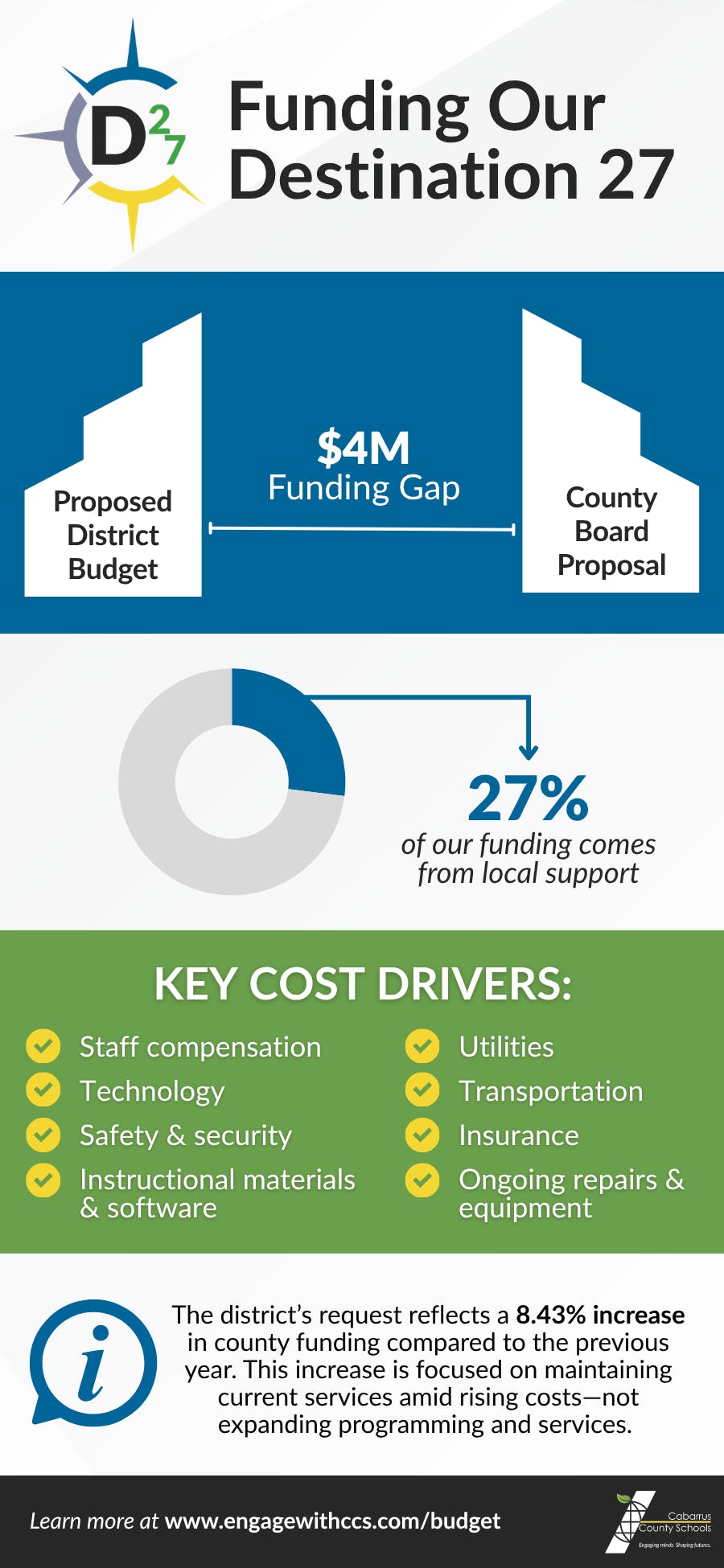

Thank you for your contribution!
Help us reach out to more people in the community
Share this with family and friends